Ongoing Research, Canada
Deconstruction, Salvage, and reuse
Circular building and construction in Canada
Summary of findings
Demolition has significant negative impacts – from creating unnecessary energy, carbon, and material waste in a climate crisis to erasing the cultural and social stories that are embedded into a place. As architects, this is a huge motivator for why Giaimo chooses to focus on circular design practices and using the existing – through adaptive reuse, renovation, retrofits, restoration, or designing additions. However, the current realities of urban growth and development leads to demolition being a highly prevalent aspect of our building industry. Many people see buildings as easily disposable, and in Toronto especially, various challenges from zoning restrictions to design quality has resulted in the demolition of numerous large buildings to make way for new construction buildings.
A more sustainable alternative to demolition is building deconstruction, which involves carefully dismantling a building piece by piece to salvage reclaimed materials. This process can happen on a variety of scales, from entire buildings to selective areas, allowing for a significant decrease in the amount of waste going into the landfills. From brick and wood to marble and finishes, Giaimo has been implementing deconstruction and material re-use on a variety of projects to conserve, and thus leverage, the existing embodied energy and carbon of a building. Our team is committed to bridging the gap between the well-established circular building and deconstruction research that exists across academia and international precedents with the current state of the real estate, construction, architecture, and building industry in Ontario.


Conceptual sketches by Giaimo (Shanze Shahbaz), exploring ideas of deconstruction and salvage with Local Technique (Alison Creba and Rashmi Sirkar) in response to the news on the future demolition of Wallace Emerson Community Centre in Toronto.
Unlocking the potential of deconstruction and policy in Toronto and Ontario
Since 2021, Giaimo has been collaborating with Local Technique, a Toronto-based non-profit leading research on the intersection of building waste, deconstruction, and cultural heritage. By exploring deconstruction solutions for Wallace Emerson Community Centre, Giaimo and Local Technique’s recent works have focused on offering pre-demolition audits to demonstrate the feasibility of building deconstruction and material reuse as an alternative to demolition and disposal in Toronto and Ontario.
While there are multiple examples across North America and worldwide, the GTHA currently lacks comprehensive precedents of, and policy for building deconstruction and material reuse. Recycling existing (LEED 4.0) and ineffective (ONT-102. ONT-103) policies. New policy that considers whole life carbon and embodied carbon is moving towards understanding the important role circularity plays, and important initiatives such as the City of Toronto’s current Circular Economy Road Map project indicate that property owners should prepare for future reuse policies and explore how to integrate these strategies and solutions into future projects.

Applying deconstruction to projects of all scales
Even in restoration and renovation projects, sometimes selective removal is required. In these instances, we initiate a process that finds opportunity to salvage and deconstruct rather than demolish. One example is 62 Mill St in Uxbridge. The removal of a century-old non-designated shed was required to make room for a new housing development. As a sustainable alternative to demolition, Giaimo offered the client an opportunity for deconstruction that would carefully dismantle the shed and salvage the wood beams. This salvaged cladding will be re-used as part of the heritage commemoration for the site’s redevelopment as well as for the restoration of heritage windows.
Deconstruction even on a small scale is not only possible but advantageous. As part of lobby renovations to a mid-century modern multi-unit residential building in Toronto, Giaimo has worked with the contractors to salvage marble and reuse it for another project that would have otherwise required new material. With this integrated approach, not only is waste reduced from one project, but the need to buy (and thus produce and manufacture material) a new kitchen counter for another project is also reduced, supporting a sustainable circular economy.


Advocacy and Capacity-Building
Our team has presented our research, expertise, and case studies at a range of events, including:
IDEAS Forum: Deconstruction, Toronto Society of Architects. A series of fast-paced presentations that explored circular construction, embodied carbon and sustainability, and material salvage and reuse. Giaimo Associate Ria Al-Ameen presented Marble and The Shed at this event in 2023.
Trash Talk Symposium, DesignTO Festival 2023. This symposium invited designers and thinkers to explore design responses to the problem of waste management. How do we design for carbon neutrality, or even carbon negativity? How are designers responsible for the environmental impact of their designs? How can we transform our relationship with waste and begin to see it as a valuable resource? Giaimo Associate Mitchell May and Creative Director Stephanie Mah each presented as part of this symposium.
Rethinking Material Values: Reuse, Deconstruction, Embodied Carbon, and Social Justice, National Trust for Canada Conference, 2023. Ria Al-Ameen presented case studies of built examples of deconstruction and material reuse on Giaimo projects.
Earth Week Webinar Series: Circular Economy, ULI Toronto, 2024. In October 2023, Giaimo’s Creative Director Stephanie Mah was part of a Canadian delegate for a Circular Construction Study Tour to Copenhagen, Denmark, organized by ULI Toronto. The findings from this Study Tour were shared in a series of webinars.

Circular Living Lab and Reclaimed Brick
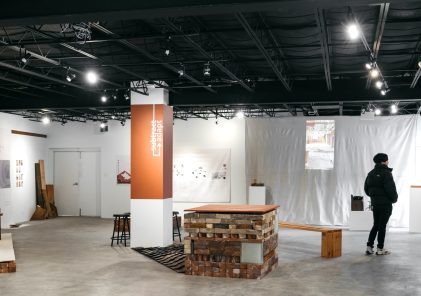
Launched as part of DesignTO Festival 2024, the Circular Living Lab was a collaborative exhibit and installation exploring sustainable design through reuse and deconstruction, material salvage, and urban mining in the built environment. Led by TAS, in collaboration with Giaimo, Ouroborous Deconstruction, Ha/f Climate Design, Haley Anderson Consulting, the Circular Living Lab asks: What if architects, designers, and builders shifted their perspective away from linear thinking, and started to see waste as a resource? The exhibit received the DesignTO 2024 Founders’ Award.
Following the success of this installation, Giaimo and Arcana Materials collaborated on a salvaged brick display at the AZURE Human/Nature Conference in October 2024 at George Brown College. The display highlighted the significant loss of historic brick through demolition happening across Toronto – wasting the embodied carbon of buildings, disregarding the craftsmanship and labour that goes into materials, and diminishing the cultural heritage of our city. It also showcased the potential for salvage and reuse, encouraging designers and city-buildings to integrate reclaimed brick into new construction projects, from landscapes to interiors.